


For many manufacturing companies, Autodesk Vault has become the backbone of engineering data management. It provides a controlled environment for CAD files, drawings and revisions, ensuring engineers can work confidently knowing the latest approved information is protected and traceable.
But as products become more complex, customers become more demanding and regulatory requirements become more stringent, a question begins to emerge:
Is controlling files enough to effectively manage engineering change?
The answer for many organisations is no.
While Autodesk Vault excels at managing product data and revisions, engineering change management extends far beyond engineering files. A successful change process must involve people, departments, approvals, business decisions and accountability across the entire organisation.
This is where Autodesk Fusion Manage can transform the way manufacturers control change.
Every Product Changes
No product stays unchanged forever.
Customer feedback can trigger enhancements. Suppliers discontinue components. Improvements can be gleaned and implemented. Quality issues require corrective action. New regulations can force revisiting designs to stay compliant.
Change is not an exception, it is a constant. The companies that thrive are not the ones that avoid change, but rather the ones who manage it efficiently and consistently with complete visibility.
Yet many manufacturing organisations still rely on a combo of Vault lifecycle states, spreadsheets, email chains and manually completed ECO forms and documents to control engineering change.
While these processes seem sufficient to fulfil a need at the time, they are often outgrown or simply not robust enough later down the line.
Revision Control is Not Change Management
One of the most common misconceptions is regarding revision control the same thing as change management. They are closely related but solve very different problems.
Vault is sublime at managing revision control.
It helps engineering teams answer questions such as:
- Which drawing version is approved?
- What changed between revisions?
- Who made the modifications?
- When was the document released?
These capabilities are essential to engineering teams effectively controlling their CAD data.
However, engineering change management is a whole other kettle of fish.
- Why was the change requested?
- What product are affected?
- What is the impact on manufacturing and current stock levels?
- Has purchasing approved supplier implications?
- Who authorised the change?
- How long did the process take?
These questions are about business processes rather than engineering files and managing them effectively required more than document control.
Signs You’ve Outgrown a Vault-Only ECO Process
As manufacturers grow to a point where the engineering team spend more time managing approvals than managing design data, some warning signs start to show, including:
ECO Forms Trapped in Documents
Change request and change order documents are created as word or PDF documents and attached to projects. This makes important information difficult to search for, report on or analyse over time.
Endless Email Chains
Approvals are gathered through email, Teams messages or in meetings (with or without notation to back it up). Decision become fragments across multiple systems, making it hard to establish an audit trail for a decision.
Spreadsheet Based Tracking
Many organisation maintain a spreadsheet to attempt to track change request and approvals. Unfortunately spreadsheets often become another source of truth rather than the single source of truth in an organisation.
Limited Visibility
Management in an engineering organisation want answer to simple questions:
- How many ECOs are open?
- Which departments are causing delays?
- What is the average approval time?
- Which projects carry the highest change risk?
Without dedicated workflows and reporting, finding these answers can become a manual exercise.
Cross-Department Friction
Engineering understand the design change.
Manufacturing understands the production impact.
Purchasing understands the supplier implications.
Quality understand compliance requirements.
Without a structure process, each department operates in isolation, creating bottlenecks and increasing the risk of missed approvals.
The Cost of Poor Change Management
The impact of ineffective change management affects far more than just engineering.
Delayed approvals can postpone product releases.
Poor communication can lead to obsolete inventory being purchased.
Missing approvals can create compliance risks.
Lack of visibility can result in management making decisions using incomplete information.
The most significant cost to an organisation is TIME.
Engineers, managers and other stakeholders in a business can spend countless house chasing, searching for and organising this information which should already be available in a single, central location.
As organisations grow, these inefficiencies become increasingly more difficult to ignore.
What Fusion Manage Adds to the Process
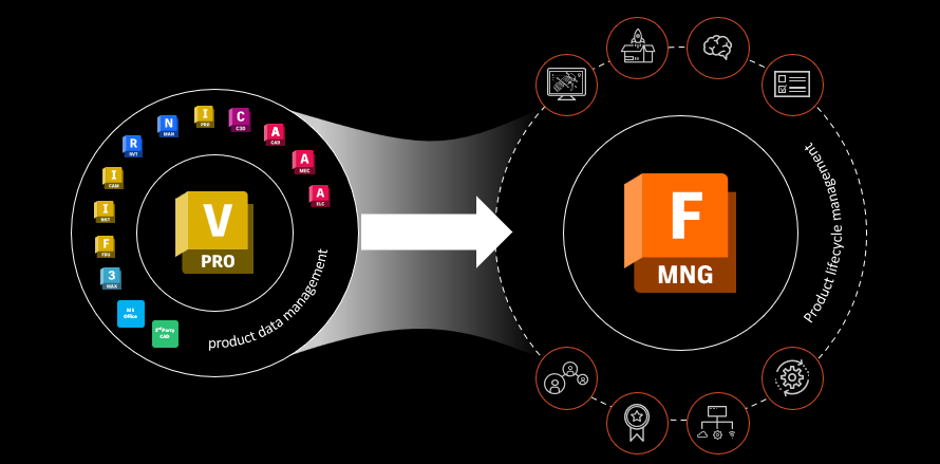
Fusion Manage complements Autodesk Vault by extending change management beyond engineering file control.
Instead of managing change through disconnected tools and manual processes, organisations can establish a structured workflow that connects all stakeholders involved in the decision-making process.
Typical capabilities include:
- Change Requests, Change Orders and Change Tasks: Capture and asses proposed changes consistently from the moment they are raised.
- Impact Assessments: Understand how a change affects products, projects, inventory, suppliers and manufacturing operations before any decision is made.
- Automated Workflows: Route approvals automatically to the appropriate stakeholders, ensuring accountability and reducing administrative effort.
- Electronic Approvals: Provide clear ownership and full traceability throughout the approval process.
- Complete Audit History: Create a single record showing who approved what, when and why.
- Real-Time Reporting: Give management visibility into workload, bottlenecks and performance trends across the organisation.
Rather than simply controlling files, the business gains control of the entire change process.
A Typical Modern Change Process
- A change request is raised.
- An impact assessment is completed.
- Engineering reviews the technical implications.
- Manufacturing reviews production impact.
- Purchasing assesses supplier considerations.
- Quality evaluated compliance requirements.
- A change control board authorises a Change Order.
- Change tasks are issued and carried out.
- Vault revisions are released in line with the approval process.
Every action is tracked.
Every stakeholder has visibility.
Every decisions is recorded.
The result is a repeatable and auditable process that can scale with the business.
Building on Your Existing Autodesk Vault Investment
One reason some organisation hesitate to explore PLM is the assumption that is requires replacing existing systems.
In reality, organisations can continue leveraging the strengths of Vault while extending their capabilities through Fusion Manage.
Vault remains the trusted repository for engineering data.
Fusion Manage becomes the platform for managing the people, processes and decisions that drive change across the organisation.
Together, they provide a foundation for more effective collaboration, improve visibility and stronger governance throughout the product lifecycle.
The companies achieving the greatest levels of efficiency are those that have moves beyond document-centric change management and embraced connected, process-driven workflows.
The question is not whether change will happen. The question is whether your business has the tools to manage it effectively.
Still got Questions?
Book Training
Through hands-on exercises, you will acquire the key skills and knowledge required to design models using Fusion. It will teach you everything from product development to simulation and fabrication.
Contact Us
We are here to ensure you receive a consistently high service and quality solutions for your business needs. We promise you won’t regret speaking to us, and if we can’t help you, we will try to find someone that can.